
Brett Haugen’s million-dollar 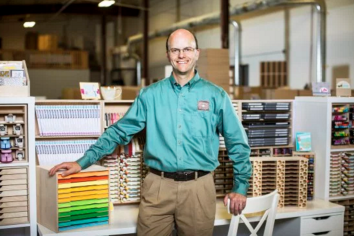 business idea hatched eight years ago when his wife, Mary, asked for a favor. She wanted him to use his design and woodworking skills to build storage units that could hold all of her crafting materials—ink pads, markers, paper punches—in one place.
Mary loved the custom cabinets he made for her, and her friends did too. Haugen, a mechanical engineer and manager at a computer-parts manufacturing company, sensed a business opportunity. “The only thing being sold in stores were generic storage units,” he says.
To test the market, Haugen built a few dozen products in his garage and posted them on eBay in early 2009. It was a good proving ground. Units that hold 48 ink pads, for instance, took 15 minutes to assemble, cost $5 in materials, and quickly sold out at $35 apiece, he says. But a display shelf was a dud. “It was generic,” he says in hindsight.
Click here to read the full story.

 for his business idea. In June 2011 his wife, Ayana, called him upstairs to watch a couple decorating their living room. “They were hanging wallpaper that had a collage of their family photos,” recalls Oliver, a father of twins. “They said anyone could do it, but I couldn’t find how to do it anywhere.”
 words like “privilege” and “opulence” often come to mind. What about “comfort”? That’s a term more commonly associated with the middle class. But while most American families enjoy creature comforts, they yearn for a more enduring variant—the peace of mind that comes from knowing you have the financial freedom to pursue whatever life you want.
 met at a 9-year-old’s birthday party in May 2011, they discussed a business idea, fittingly, for children. They arrived with their kids, who went to school together, and Bers buttonholed Rosenberg—who had a background in engineering and marketing—to discuss a prototype she was developing: A robotic toy that teaches problem-solving skills to 4- to 7-year-olds using computer science principles.


 a room give you the jitters? Networking functions can turn even successful professionals into tongue-tied teens. Some people have such a visceral reaction that they actually feel physically dirty, a University of Toronto study found.
 you probably have two or three vehicles in your driveway: one for yourself, one for a spouse, maybe one for a teen. Indeed, 57% of U.S. families own two or more cars, KPMG found. Between gas, maintenance, fees, and insurance, the average cost to owners was $4,375 per vehicle in 2015, AAA found—even while fuel prices plunged. That’s money that you could be using for family trips or retirement planning. (The cash you’ll get by selling won’t hurt either.)
 in your 20s, 30s, 40s, 50s, 60s, and beyond? Check out my series for Money.com’s 2016 career guide, starting with
 since most families want to move when the kids are out of school. Yet it actually pays to list in the winter, when buyers tend to have more urgency: A study by online brokerage Redfin found that average sellers net more above asking price during the months of December, January, February, and March than they do from June through November, even in cold-weather cities like Boston and Chicago. And homes listed in winter sold faster than those posted in spring.

 Daniel Bortz